In our Vallée de la Sanaon, neon light flowed like milk and honey over the ketchup and plastic, but what did it matter! 1
The billboards of Times Square cluster, blink, and flow, constructing a grand altar of signs with their dizzying slogans, product images, and models. This mode of encirclement by images has surpassed the traditional glass display case: a static display merely emanates seduction from its place, but the moving image is violent.
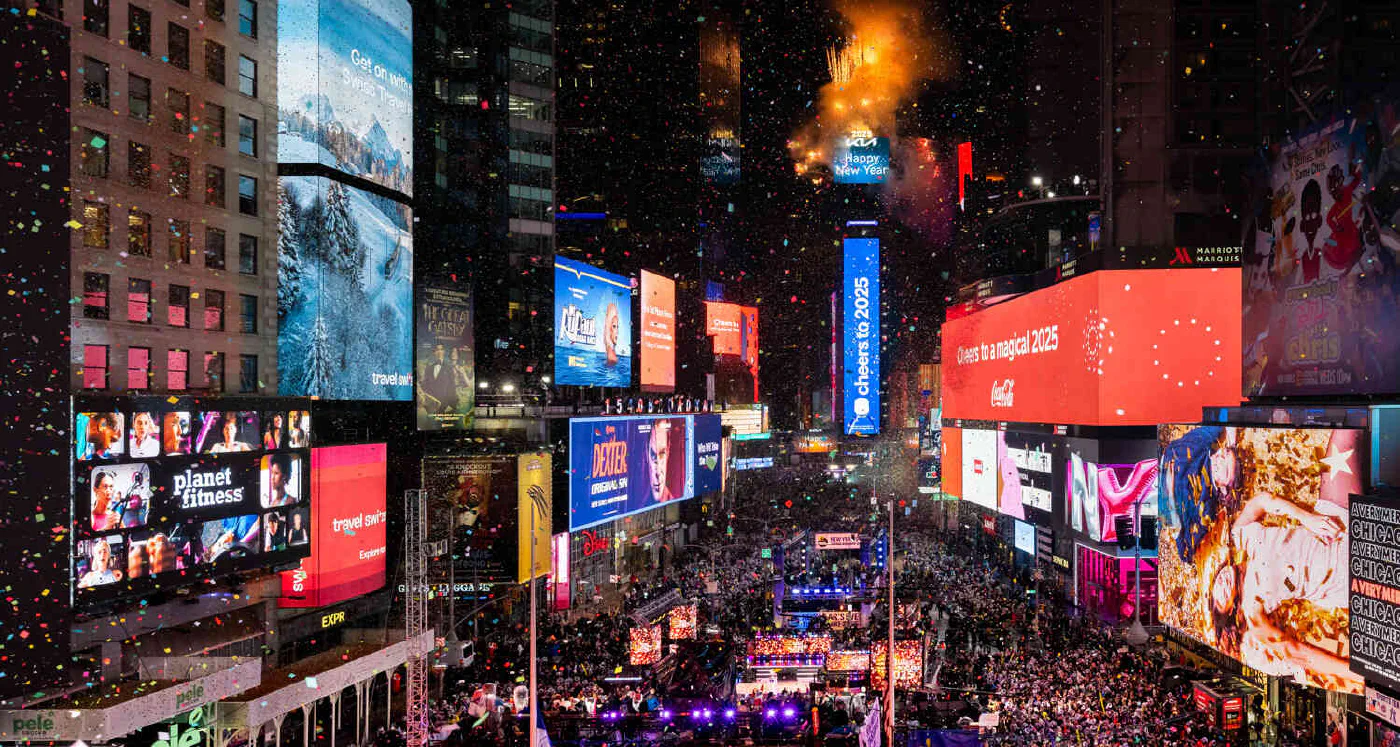
It dismantled the territory in which observation could freely unfold, bringing things alarmingly close and rushing them toward us, the way a car on the cinema screen grows enormous and charges at us. 2
The images on Times Square’s billboards possess the dual face of the imperative and the indicative. 3 They create an illusion that seems to have fused the boundary between everyday life and the mythology of consumption, while simultaneously threatening the viewer with a more covert terror. The slogans, product images, and models on the billboards expose their cheerfulness, harmlessness, and efficacy as much as possible, yet the life-illusion they simulate is charged with suggestive unease: overly garish colors undergo ceaseless transformation, sculpted and unnatural slogans are layered on top, and beside them stand performers fully aware they are being photographed. Every attention-grabbing element, through the editing and post-processing of images, aims to issue a coercive “imperative” to visitors.
In the world where the real has made itself into mere images (simples images), these mere images become real beings, the effective motivations of a hypnotic behavior. 4
Yet a raw “imperative” alone cannot convince anyone; it may even provoke resistance. To counter this, Times Square’s “indicative” function neutralizes the billboard’s external violence, glossing over the crudeness of its “imperative”: it constructs a fantasy drama of the ideal life, with the visitor as the audience seated at center stage. Times Square’s theater operates on the same principle as Universal Studios, essentially a theme park; Universal Studios places shops at the exit after the ride, but Times Square skips this step entirely, merging the experience of play with the act of purchase. Along with it, the boundary between reality and simulacrum dissolves. Times Square’s resplendent billboards invade reality in a dynamic manner, in motion day and night, warping people’s perception of time. “The reality of time has been replaced by the advertisement of time.” 4 The merchandise in the billboards is placed in a subordinate, promotional position, while the more fraudulent value propaganda is brought to the foreground. Under the guise of dazzling lights, vitality, and hope, the billboards ceaselessly broadcast dreams and desire, closing in step by step on the people moving through the streets below, drawing them into the phantasmagoria of commodity fetishism. What Benjamin said: “What, in the end, makes advertisements so superior to criticism? Not what the moving neon sign says, but the fiery pool reflecting it in the asphalt.” 2 It may be just that: the content and meaning of advertising point toward emptiness, yet these image compression walls, with their countless glowing billboards and the ceaseless operation of their shops, have seized the grand, epic title of “center of the universe.”
In the clamor of dusk, an old man with a face full of white hair slumps behind the canopy of his small stand. On the wall of the building beside him is a massive chocolate advertisement screen; beneath the screen, the floor-to-ceiling windows glow with warm rings of orange light. New York’s strong wind squeezes the old man’s eyes, deflating them like leaking balloons. The old man strains to force his bulging eyes through his exhausted lids, watching the silent dance on the advertisement screen, the building’s mute reply, and the plastic trash bags sent skyward by the wind like floating lanterns.
Jean Baudrillard, The Consumer Society, trans. Liu Chengfu / Quan Zhigang, Nanjing University Press, 2014, Ch. 1: The Formal Liturgy of the Object, Profusion ↩︎
Walter Benjamin, One-Way Street, trans. Wang Yong, CITIC Press, 2021, “Walls for Rent” ↩︎ ↩︎
Jean Baudrillard, The System of Objects, trans. Lin Zhiming, Shanghai People’s Publishing House, 2019, Part IV: The Social Ideology of Objects and Consumption, Ch. 9: Advertising, The Imperative and Indicative of Advertising ↩︎
Guy Debord, The Society of the Spectacle, trans. Zhang Xinmu, Nanjing University Press, 2017, Ch. 1: Separation Perfected, §18 ↩︎ ↩︎