Introduction
Victorian British fashion was extravagant and expressive, yet it imposed enormous constraints on the female form — but women’s struggle ultimately ensured that these garments were replaced by healthier silhouettes. This chapter centers on the Victorian and anti-Victorian, alongside the advance of the Industrial Revolution and modernization.
Romantic Era Fashion
This was the period when the divergence between men’s and women’s dress reached its most extreme point. Women’s garments were almost universally low-cut (round, V-shaped, or off-shoulder), high-waisted A-line plaid skirts, with enormously puffed sleeves that emphasized a wide bust and narrow waist. In pursuit of the wasp waist, the structures of these garments gradually hardened, producing a distinctive female silhouette while making the wearing experience increasingly unpleasant.

African Kente Cloth
In Africa, hand-spun and dyed yarns were still considered luxury goods in the 17th century, but as technology gradually advanced, cotton cloth became a daily commodity. Particularly characteristic is the warp-and-weft weave — striped patterns running in both directions. The development of weaving machinery after the 19th century led to an increase in weft-float patterning, while new fabric types, patterns, and color combinations had not yet been introduced by the early 19th century. These aspects developed in the modern era, and Kente cloth continues to evolve and remain in fashion today.

Latin American Fashion
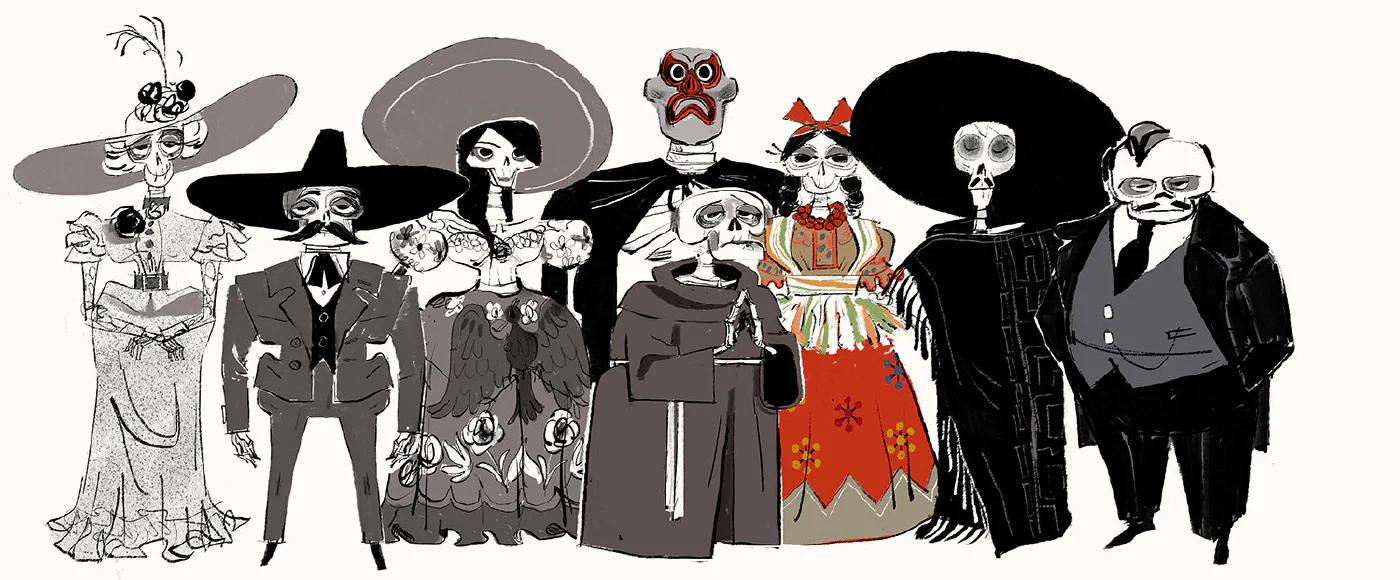
The film Coco is deeply Latin American in character. From the Wikipedia description: “The film’s concept was inspired by the Mexican holiday Día de los Muertos”; “Pixar began developing the film in 2016, and Unkrich and some of the film crew visited Mexico for inspiration”; “the voice cast is entirely Latino.” The fashion depicted in the film is equally distinctive: the Mexican charro style embodies the uninhibited, exuberant boldness of Latin American performers. First, the hats: the cowboy hat, wide-brimmed sombrero, and sombrero panamá (it should be noted that the Panama hat did not originate in Panama). Women’s dress in the Americas was far more varied than European court fashion — some Spanish women, for instance, wore narrow wrap shawls, loose lace-trimmed blouses, and occasionally sequined skirts. Contact with Europe, particularly with the rise of fashion magazines, influenced Latin American dress, and the sewing machine made home dressmaking possible. Latin American women writing for fashion magazines also mourned the restrictions that European corsets and layered garments imposed on women’s bodies.
The Victorian Era
In the mid-19th century, as Coventry Patmore’s poem describes the “Angel in the House,” the idealized Victorian woman was confined to the domestic sphere. This regression stood in stark contrast to the advances of industry, technology, and the expansion of the British Empire. The bourgeoisie replaced the feudal order; men adopted well-tailored dark clothing while women wore enormous, heavily ornamented garments. Veblen, in The Theory of the Leisure Class, argued that lavish dress was the mark of the forced leisure imposed on Victorian women, who were the living embodiment of conspicuous consumption and their husbands’ wealth. Victorian dress saw the bell-shaped skirt grow ever larger, more layered, and more ornate; the crinoline grew ever stiffer and taller; fabrics grew ever more luxurious; and the corset grew ever tighter, to the point where it could fracture ribs and cause death. Mass production rather than custom tailoring made outer garments less form-fitting; the development of transport made shopping a major leisure activity. All of this allows us to see the devastating predicament women faced as consumerism and capitalism took hold. Women’s social freedoms did expand somewhat, however. It was not until the late Victorian era that fabrics grew softer, reflecting the growing demand for women’s liberation — and when women gained the right to vote, the Victorian era ended. Associate Professor Tan Saihua of Hunan Normal University’s School of History and Culture writes in her article “The Transformation of Late Victorian Women’s Fashion in Britain
”:
Late Victorian women’s fashion in Britain acted like a mirror of society’s turbulent changes, keenly reflecting social transformation. On one hand, women’s fashion of this period featured brighter colors, crisper synthetic fabrics, and lower production costs — fruits of the rapid development of Britain’s chemical, textile, and garment industries through two Industrial Revolutions. On the other hand, the elaborate, ostentatious aristocratic fashions of the late Victorian era were supplanted by the clean, practical styles of the middle class, reflecting the beginning of the aristocracy’s decline and the gradual emergence of the middle class as the backbone of British society. At the same time, as educational reforms were implemented in the second half of the nineteenth century and more women entered the workforce, women’s self-awareness began to awaken; they strove to break free from the shaping and disciplining imposed by men, liberating themselves from the constraints of traditional dress and adopting clothing suited to the fast-paced rhythms of modern life — a visible declaration of women’s liberation.
It is worth noting that Lolita fashion (ロリータ・ファッション) frequently uses lace, frills, ribbons, and bows in its design — this is primarily due to its influence from French Rococo and English Victorian dress. Lolita will be covered in more detail in a later article.
German Chancellor Bernhard von Bülow remarked of Edward VII: “In that transition, when the dress of a gentleman was unquestionably the most elegant, he was the most elegantly dressed gentleman.” This reflects the rise of the gentleman aesthetic. The garments produced by English tailors were clean and well-structured; the gentleman’s suit evolved from the styles previously discussed into the frock coat (front skirts cut away) and the morning coat (front cut on the diagonal), with trousers replacing breeches. The Prince of Wales later made one further modification, cutting away the back tails entirely — and from this the more conventional lounge suit was born, embodying meticulous attention to detail and a noble simplicity.

The Birth of Haute Couture
The explosion of capitalism and consumerism meant that fashion was no longer the exclusive domain of the aristocracy. British designer Charles Frederick Worth elevated dressmaking to the level of haute couture, and posterity named him the “father of haute couture.” He had apprenticed at a department store and studied French fashion, later winning a gold medal at an international design exhibition; his own fashion house, House of Worth, revolutionized the fashion business and achieved enormous commercial success, even helping to establish the Ladies’ Garment Workers’ Union and the Chambre syndicale de la haute couture.
At the height of his success, he reformed the Victorian era’s enormous crinoline, making it narrower at the sides and front to become more practical. He then abandoned the crinoline entirely and created the hugely influential “princess line” — a silhouette with no defined waist seam, the skirt formed by vertical panels of triangular cloth sewn together, presenting the body’s shape in a more natural way. 20th-century fashion brands have frequently used this cut; Dior, for instance, has a princess-line based fashion collection.

Japan in the Meiji Restoration
The end of Japan’s sakoku policy opened the possibility of trade and travel abroad. It was also during this period that Japan recognized modernization as essential to resisting European and American colonialism, and so an elite-led, voluntary reform of dress and military took place. Military and Western-style suits became critically important, and some architectural styles also borrowed from the West. Western women’s dress at this time — the crinoline — was hardly a favorable development for women, and Japanese women found it difficult to adopt Western dress in a way that suited modern life (a problem that remained unsolved even by century’s end). Fashion that had previously been the exclusive domain of the samurai class became accessible to all during the Meiji Restoration (with the exception of the crinoline), and merchants and notables frequented venues like the Rokumeikan entertainment hall in Tokyo. Western swept-back hairstyles became fashionable, but due to differences in hair texture, the Japanese adapted them into a combination of Japanese and Western styling, producing the yōkaimaki. Women stopped shaving their eyebrows and blackening their teeth, while men began growing mustaches and chin beards.

Pre-Raphaelite Art and Aesthetic Fashion
The “Aesthetic Style” was another force challenging the Victorian crinoline. Its characteristics were the fitted bodice gowns of medieval artists, simple low necklines, and hanging sleeves and skirt folds. The style was later influenced by Japanese art and began to incorporate kimono-inspired elements; Oscar Wilde famously wore Aesthetic dress for his 1882 lecture tour. Initially a fringe style, it gradually gained acceptance as avant-garde fashion developed.

The American Style Archetype

American women’s rights leader Frances Willard promoted women’s cycling as a challenge to both the Victorian crinoline and the claim that “cycling causes serious physiological harm to women.” Irene Langhorne, through illustration, created the progressive-era feminine ideal: the Gibson Girl. In those illustrations, the Gibson Girl was devoted to art, sports, politics, and commerce; she attended university, stood equal to men, and took part in the workforce — an unmistakable embodiment of American women’s liberation and independence. And yet the hourglass/S-curve figure of the Gibson Girl brought the corset back into fashion, making Willard’s campaign rather ironic. The most famous Gibson Girl, Camille Clifford, had a waist of only 45 centimeters; the early death of her child was almost certainly connected to her extreme corseting. It is worth noting, however, that the mannish shirtwaist also became fashionable in America at this time, allowing women to move freely — particularly on the golf course.
French Belle Époque Fashion
The Arts and Crafts Movement in Britain gave way to Art Nouveau, which spread across Europe and America and influenced architecture, furniture, products, jewelry, clothing, graphic design, book illustration, sculpture, and painting. (Wang Shouzhi, 2002-09) This was yet another reaction against the affectations of the Victorian style, moving decisively toward naturalism (ornamentation favoring plant stems over petals). French Belle Époque fashion was a reflection of Art Nouveau, developing the “health corset,” which eliminated the organ displacement, indigestion, and difficult childbirth caused by the Victorian corset. Simple brassières and garter belts began to develop, and the narrow skirt became fashionable. Paris remained the center of the finest designers, including important figures such as Jacques Doucet and Paul Poiret. The first British designer to receive international acclaim, Lady Duff-Gordon (Lucy Duff-Gordon), invented the fashion show, popularized less restrictive corsetry, declared that design should reveal the personality of the client, and became the model for later fashion empires such as Chanel and Dior. She was also a survivor of the Titanic.

Conclusion
We have now reached roughly the midpoint of fashion history. In the next chapter — the first half of the 20th century — truly sweeping fashion will emerge, bringing Chanel, the Zhongshan suit, Modernism, Surrealism, and the fashions of America and Russia. Of course, this period we have just covered marks only the origin point of modern fashion concepts; the second half of the 20th century will be when fashion truly diversifies and flourishes in earnest.
Reference
Wang Shouzhi. A History of Modern World Design. China Youth Press, 2002-09.
The above content is based on and compiled from The Complete History of Fashion.