Introduction
The fashions of this period feel far more familiar to us than those of the pre-17th century. We recognize the oiran’s dress, the gentleman’s suit, the tartan — and the famous figures born in this era (Newton, Bach, and others whose images appear endlessly in modern films and textbooks) have made us notice their distinctive styles. The world order shifted and new technologies emerged, bringing with them enormous changes in fashion; it is in this period that a recognizably modern fashion industry was born.
Edo Japan
Edo-period Japan was exceptionally prosperous, and the textile and commercial industries flourished. After Miyazaki Yūzen refined the Yūzen dyeing technique, the kimono underwent a great leap in quality. Until the end of Japan’s sakoku (closed-country) policy, the kimono developed without any outside influence. The shogunate issued sumptuary laws of varying degrees of enforcement, which made the conventions of Japanese dress more complex and nuanced — the strict sumptuary laws of the late Edo period, for instance, did not apply to the consumer culture and class dynamics of the Yoshiwara pleasure quarters. The yūjo (courtesans) became cultural icons. Among them, the oiran stood at the absolute pinnacle — and the oiran’s dress is the most iconic fashion of the period. Oiran held high social status; becoming one was no easy feat, and even gaining access to an oiran’s services was harder still. They also developed a distinctive speech pattern called kuruwa kotoba, in which sentences ended with arinsu (Tōkyō Jihen famously used this ending in the opening of Shiina Ringo’s part during the “Kenka Jōtō” performance at the Just Can’t Help It live concert in 2006). The legendary oiran figure appeared not only in literary works like Mori Ōgai’s Vita Sexualis and Higuchi Ichiyō’s Takekurabe, but also across popular culture: in Demon Slayer’s Entertainment District arc, Yūgiri in Saga of Tanya the Evil, the film Yoshiwara Enjo, the film Sakuran and the original soundtrack Shiina Ringo created for it, and Adachi Yumi’s stylistic departure film Hana Yori mo Hana no Gotoku. Kasumi, Rem, Kurumi, and others also have oiran-style figures and body pillows. The oiran kimono features the nuki襟 (pulled collar), the maemisubi (front-tied obi), and elaborate hairpieces including kōgai, kanzashi, and kushi. Just the hairpieces alone could cost as much as a house. Their garments could weigh up to 30 kilograms, and their wooden sandals could stand 30 centimeters tall. The article 花魁道中|コスプレする前に知っておきたいファッションの由来 | モンスペディア
provides more detail:
To become an oiran — a high-ranking courtesan — maintaining one’s beauty was absolutely essential.
Skin as white as snow and hair the color of a wet crow’s wing were the standards of beauty of the era.
Particular effort was devoted to the care of one’s feet.
Unlike today, in the Edo period it was common to go barefoot outside of the coldest months.
For the people of Edo, who valued iki (stylishness) above all else, bare feet were a non-negotiable condition.
But if neglected, the feet quickly became dirty and rough, betraying an ordinary, lived-in life.
For the oiran, whose entire appeal lay in the extraordinary, one could not have feet that looked like they belonged to an everyday city dweller.
They cared for their feet meticulously, applying white powder all the way to the tips of their toes to preserve their beauty.
It is also said that their undergowns and skin coverings (undergarments) were made in red, designed to create contrast with their white feet.

The Interregnum under Charles I
The court dress of Charles I’s era was restrained, elegant, and unshowy — muted tones, clean lines, a romantic sensibility. Stiff doublets and ruff collars were discarded in favor of wide, soft falling collars with lace trim, worn with breeches and long boots. The ideological split between Charles I and Parliament also produced two distinct styles of dress: Royalist and Parliamentarian. Parliamentary dress was plainer, influenced by Dutch bourgeois styles — though English dress of this period was generally quite austere all around.

Qing Dynasty China
If the fashion of this era’s China must be represented by a single garment, it would undoubtedly be the dragon robe (longpao) — though of course that could never have been a trend anyone followed. Qing ceremonial dress varied in color according to context, and the dragon robe was the most formally ranked of all ceremonial garments. It featured dragon motifs, horsehoof cuffs, wavy hem embroidery, and its characteristic buttons. Personally, I find it rather ugly. I’ll leave it at that.

French Court Fashion
The modern fashion industry originated in 17th-century Paris. Louis XIV’s finance minister Colbert sought during this period to establish a French monopoly on textiles and make France the center of luxury consumption. From 1661 to 1789, French court fashion reached its height of splendor; the courts of Europe followed suit, indulging in its opulence (even as they issued their own sumptuary laws). Men’s dress consisted of a long outer coat, waistcoat, and breeches (the prototype of the modern suit); women wore open robes and silk mantua-style gowns. The tall lace fontange headdress appeared; fashion periodicals were born; men no longer monopolized the accessories market; the female dressmaker gained professional standing; and French fashion ascended to dominance. The fashions of this period were both luxurious and restrained, and the train became widely fashionable.

English Restoration Fashion
After Charles II returned from exile in France, he introduced French fashion elements: doublets and breeches were discarded in favor of the sleeved waistcoat. Men took to wearing wigs, and the mantua gown made its appearance.
Louise de Kéroualle, the king’s most favored mistress, is depicted by Peter Lely wearing a loose déshabillé (undress gown). This type of gown, with its draped folds, is the origin of the mantua. The gown is unadorned and plain; the dark silk drapery contrasts with her smooth, fair skin and the fullness of her sleeves, lending Louise de Kéroualle an alluring, sensuous quality.

The Birth of Modern Fashion
Paris: fashion capital of the world.
The Enlightenment liberated thought, and people began to dress more freely. Marie-Jeanne Rose Bertin seized this moment to the fullest — she not only created extraordinarily expensive and lavish garments for Queen Marie Antoinette, but also designed casual fashions for ordinary people, and thus became the first celebrated French fashion designer, bringing fashion to the forefront of popular culture. Women’s fashion dispensed with the panier and boned petticoat, becoming far more comfortable and ceasing to distort the female form. Parisians were dazzled by Rose’s designs, and a fashion wave swept across Europe. This period saw the emergence of the Watteau gown, the robe à la française (sack-back gown), and other relaxed styles.

Scottish Tartan
The tartan kilt has become nearly synonymous with Scottish identity — yet after Highland culture was suppressed, it survived only in portraiture, not re-entering fashion until the late 18th century.

Rococo
After the extravagant Baroque era came the elegant Rococo. Rococo derives from the French words for “small stone” and “shell.” This style is still beloved by many today, for its soft pastels, delicate sinuous lines, and light touch, and for its use of natural, asymmetrical, and swirling motifs — with Eastern elements making their appearance as well. The most iconic expression of the style is François Boucher’s portrait of Madame de Pompadour: roses, ribbon bows, pearls, lacework — the whole figure resembles a brilliant bouquet. Pleats, lace, and abundant ornaments appear frequently in Rococo fashion — openwork ivory fans, walking canes, eyeglasses, smelling salts bottles, sashes, turned-back pockets, and hats adorned with flowers and feathers, and much more besides. Headwear grew increasingly extravagant; and not only in France — English dandies of the period also favored bizarre hairstyles.

Late 18th-Century English Gentlemen
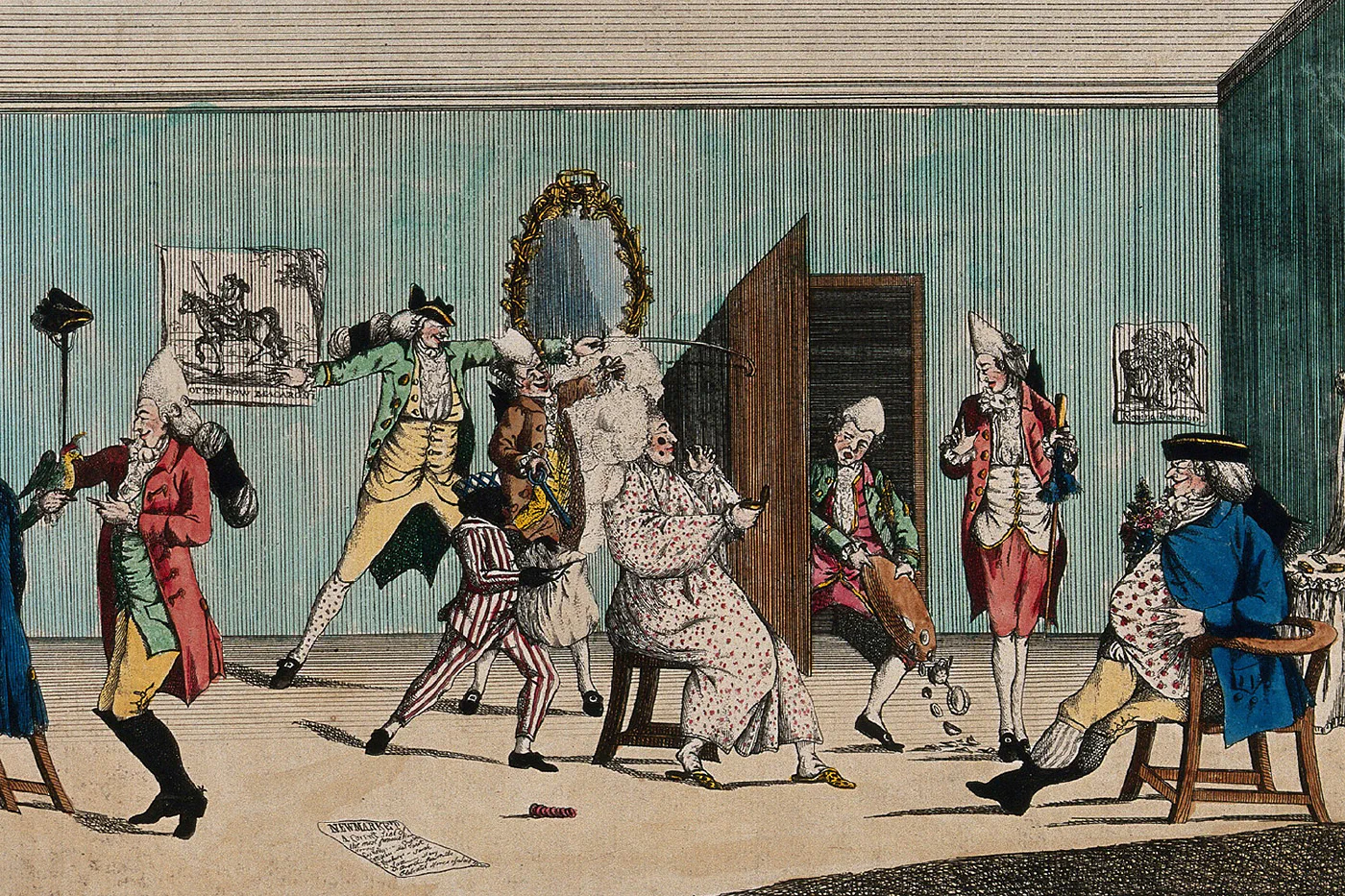
“Ask diligently and advance earnestly” is the motto of Qibao Foreign Language Primary School in Shanghai. The school prides itself on strict discipline and aims to cultivate future gentlemen and ladies. It cites a quote attributed nowhere credibly — supposedly “on the wall of Harvard’s library”: Study like a dog, play like a gentleman. This example alone reveals how far the influence of English gentleman culture has reached; the gentleman’s style of the late 18th century had swept across Europe.
Since gentlemen regularly engaged in leisure activities like hunting and shooting, their clothing needed to be durable and practical — not unlike the practical hufu garments of earlier China. They abandoned silk, satin, lace ruffs, stockings (worth noting that stockings and high heels were originally markers of upper-class status — Louis XIV of France famously wore them to display masculine vigor and physical attractiveness), and powdered wigs, turning instead to cashmere and worsted fabrics. The masculine ideal of the period was the broad-shouldered, long-legged figure derived from ancient Greek sculpture, and garment colors approaching skin tone were chosen to evoke that sculptural quality. Neckwear also became a point of focus, with styles including the “Oriental,” the “Mathematical,” the “Ballroom,” and others.
The English dandy style is equally iconic — many will recognize it at a glance. It still pursued the sculptural ideal, and was thus cut close to the body; it also borrowed from cavalry uniforms to allow ease on horseback.
Neoclassicism
Just as architecture had its Classical Revival, fashion had its Neoclassicism. The French Revolution transformed the political and social landscape of Europe; the excavation of Pompeii accompanied a fundamental shift in fashion: the luxurious ornamentation and costly fabrics of the Rococo era were abandoned, and the aesthetic turned back toward ancient Greek aristocratic dress. France remained the fashion capital, while Britain retained the gentleman’s suit and military dress but simultaneously began to adopt the new fashion style.
The representative garment was the loose, sleeveless, waistless chemise dress. Without corsets, crinolines, or other understructure, this garment was loose and comfortable, giving women’s bodies a degree of freedom they had not previously enjoyed. However, unlike the mantua, this dress could not be sewn with pockets, making the handbag necessary. Fashion periodicals also began to proliferate at this time — Journal des dames et des modes, Gallery of Fashion, and others.

Conclusion
The next installment covers 19th-century fashion. Key events of the 19th century include the independence movements of Latin America, the birth of haute couture, Japan’s Meiji Restoration, the emergence of an American style, and the evolution of Aesthetic and Art Nouveau fashion. The clothing industry underwent rapid transformation — though the inhumane Victorian style still loomed over this period. The practice of foot-binding, it should be noted, was not abolished until the fall of the Qing Dynasty, a reminder that women in relation to fashion remained in a position of control and constraint. In the 20th century, truly modern fashion would finally flourish; and it is in that era that women’s liberation of thought, and the modern fashion iconoclasts — Chanel, Rei Kawakubo — would gradually emerge.
The above content is based on and compiled from The Complete History of Fashion.